
A diamond jubilee moment
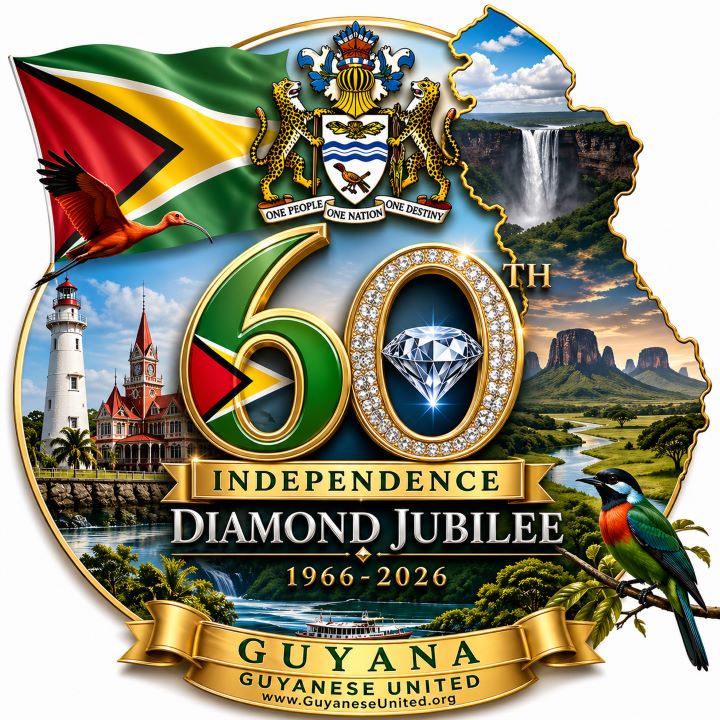
In 2026, Guyana marks 60 years of Independence, a diamond jubilee captured in the Golden Arrowhead, the national coat of arms, and the lush rivers, mountains, and waterfalls that define our homeland. This milestone is more than a date on the calendar; it is an invitation to remember where we came from, to measure how far we have traveled, and to decide together where we are going next.
Midnight in 1966: The birth of a nation
Shortly before midnight on May 25, 1966, thousands of Guyanese gathered at what was then Queen Elizabeth National Park (now the National Park) to witness the lowering of the Union Jack and the hoisting of a new flag: the Golden Arrowhead. As the clock struck midnight and May 26 began, British Guiana became the independent nation of Guyana, ending more than a century of colonial rule and becoming the only English‑speaking country on the South American mainland.
Under the leadership of Prime Minister Forbes Burnham, and with the world watching, constitutional instruments were formally handed over in the Public Buildings, marking Guyana’s admission to the Commonwealth as a sovereign state. The presence of international dignitaries, including the Duke of Kent and representatives from dozens of countries, signaled that a new nation had taken its place among the family of nations.
That day was filled with pageantry: military parades, cultural performances, and the proud, first official raising of the Golden Arrowhead by Guyanese hands. For many who stood in the dew‑damp grass of the National Park or crowded around radios, Independence felt like a long‑awaited sunrise after generations of struggle and sacrifice.
The founding vision: One People, One Nation, One Destiny
Guyana’s national motto, “One People, One Nation, One Destiny”, was adopted at Independence and was intended as a clear moral compass for the young state. It expressed the hope that a land of Africans, Indians, Indigenous peoples, Portuguese, Chinese, and Europeans could build a single national identity without erasing the richness of its many cultures.
“One People” called on citizens to see themselves first and foremost as Guyanese, committed to mutual respect and to dismantling racial and political divisions. “One Nation” spoke to building strong democratic institutions, shared citizenship, and fair development from the coast to the hinterland, ensuring that no region or community would remain invisible.
“One Destiny” pointed toward a future in which all Guyanese would share in the benefits of development, guided by equality, dignity, and justice. It was a promise that the wealth of the land, from gold to rice, from sugar to bauxite, from forests to rivers, would serve the common good and not only the few.
Sixty years on: A new era of opportunity and responsibility
Today, as we celebrate 60 years of Independence, Guyana stands at another defining crossroads: an emerging energy powerhouse with vast offshore oil and gas reserves and, at the same time, a global leader in forest conservation and climate action. Through the Low Carbon Development Strategy (LCDS) 2030, Guyana has pledged one of the world’s most ambitious transitions, aiming to grow the economy by up to fivefold while keeping energy-related greenhouse gas emissions at near-2019 levels.
The core of this strategy is to move away from expensive, polluting heavy fuel oil toward a diversified mix of natural gas as a bridge, hydropower, solar power, and wind power. The Gas‑to‑Energy project, expected to significantly reduce electricity costs, is designed to power industry, reduce the cost of living, and support a more competitive economy for future generations.
At the same time, Guyana’s intact forests, among the most pristine on Earth, are being leveraged through payment‑for‑forest‑services mechanisms to fund development in Indigenous and rural communities. This model aims to prove that a country can protect biodiversity, store carbon, and still deliver modern health care, education, infrastructure, and jobs to its people.
Living the motto today: Citizens and government in partnership
For the promise of Independence to be fully realized, the national motto must move from banners and official seals into everyday life. Across Guyana and throughout the diaspora, citizens are already doing this through community organizations, professional associations, faith communities, and cultural groups that deliberately bring people together across race, class, and political lines.
Government policy also plays a crucial role. Investments in roads, bridges, river transport, and airstrips are helping to link the hinterland with the coast, creating real opportunities for business, tourism, and services in regions that were once marginalized. Education reforms, scholarships, and technical training programs seek to prepare young Guyanese for careers in engineering, health, digital technology, and the green economy, so that local talent leads national progress.
At the village level, especially in Indigenous communities, Village Sustainability Plans under the LCDS framework give residents a say in how low‑carbon funds are spent, from renewable energy systems to eco‑tourism projects and improved social services. This emphasis on participation reflects the original Independence ideal that development must be for and by the people, not imposed on them.
Challenges that must still be faced
Yet, the work of nation‑building remains unfinished. Persistent inequalities, perceptions of ethnic and political exclusion, and uneven access to resources continue to test Guyana’s unity. Rapid economic growth, if left unchecked, can deepen divides between those who benefit quickly and those who are left waiting in the shadows.
The environmental responsibilities of oil and gas production are equally serious. Guyana has committed to strict flaring standards and best‑available technology to limit the sector’s impact, even as it advocates internationally for fair treatment of lower‑carbon producers. Balancing immediate revenues with long‑term sustainability will require vigilance, transparency, and a culture of accountability from both government and citizens.
Civil society voices, journalists, academics, activists, artists, and ordinary citizens will be vital to ensure that development remains inclusive and rights‑based. The dream of a Guyana where every child, on the coastland and in the interior, feels equally valued and equally hopeful depends on the courage to confront injustice wherever it appears.
A shared destiny: Guyana at 60 and beyond
As Guyana celebrates its 60th Independence anniversary, the images that surround the Diamond Jubilee emblem, the Kaieteur Falls, the lighthouse, the rivers, the mountains, the birds, and the Golden Arrowhead, remind us of both beauty and responsibility. Our natural wealth is extraordinary, but our greatest treasure remains our people: diverse, creative, resilient, and determined.
To truly honor the generation that stood in the National Park in 1966, this generation must commit again to building “One People, One Nation, One Destiny”, not as a slogan, but as a daily practice. That means rejecting the narratives of superiority or suspicion, insisting on fairness, and choosing cooperation over division as Guyana navigates its oil era and low‑carbon transition.
On this Diamond Jubilee, Guyanese at home and abroad are called to a simple but profound task: to leave the country stronger, fairer, and more united than we found it. If we succeed, future generations will look back on 2026 as another turning point, a moment when a confident, independent Guyana stepped into its destiny, not just rich in resources, but rich in justice, opportunity, and shared pride.

